
Breast Pump Flange Size Guide: How to Find Your Fit
If pumping hurts, or you're sitting there for 30 minutes and getting very little, your flange size is one of the first things I check. Many mums in Singapore are still pumping with the size that came in the box, and it often isn't the right one.
The good news? Finding your fit is simple once you know what to measure. Here's how I guide mums at home visits and in our Pumping 101 workshop.
Step 1: Measure your nipple, not your areola
Your flange size is based on the width of your nipple only, measured across the middle. The areola (the darker skin around it) is not part of the measurement.
Measure before you pump, when your nipple is at rest. Right after pumping, the nipple is often swollen and measures bigger than it really is.
Place the Silicone Nipple Ruler gently over your nipple.
Find the opening that fits snugly around your nipple without squeezing it.
Note the number in mm. Measure both sides: it's common for them to be different.

Step 2: Choose your starting flange size
Use your measurement as a starting point, then trial sizes around it.
Your nipple measures, e.g. 17 mm: start at 17 mm.
If 17 mm feels tight or rubs: try 18 mm, then 19 mm.
Most mums need to try 2–3 sizes around their measurement to find the one that feels comfortable and drains well.
Step 3: Check the fit while you pump
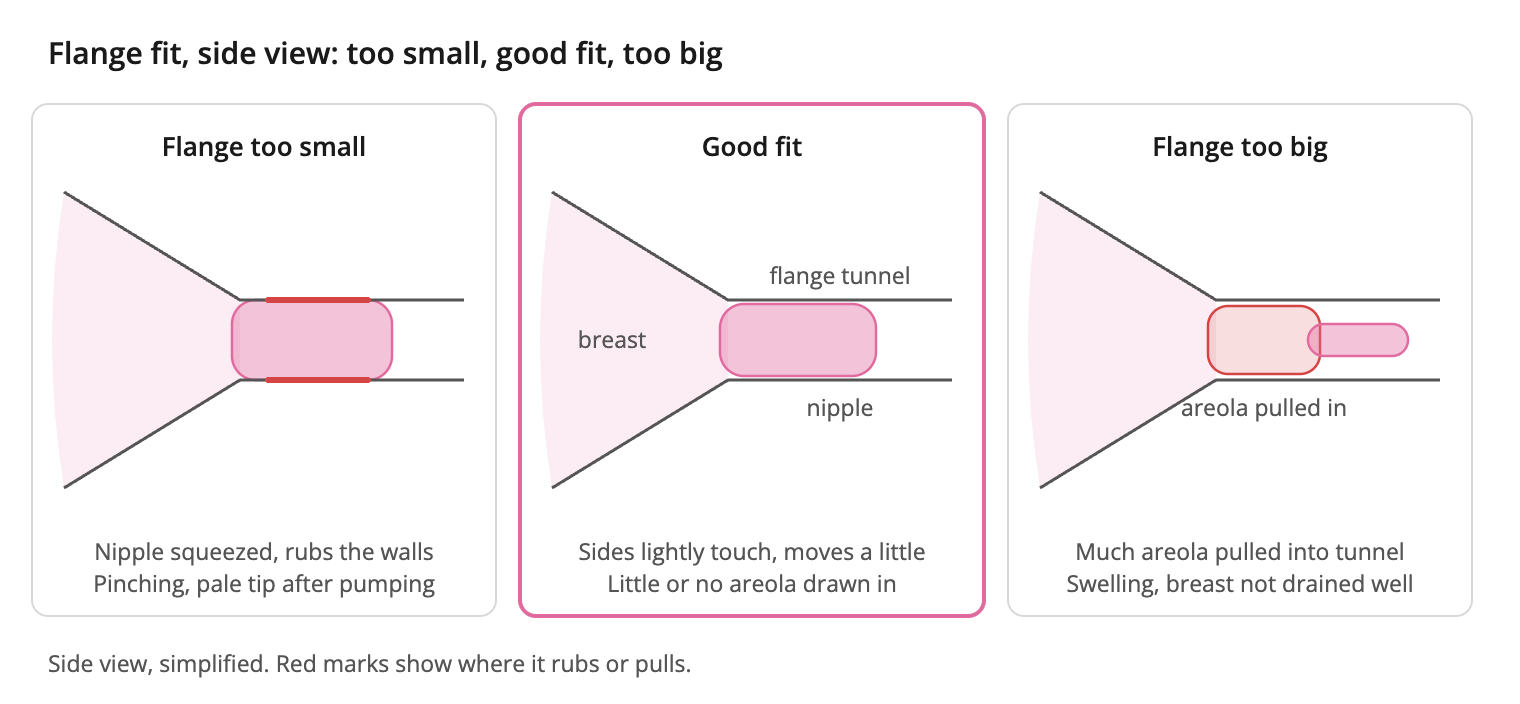
A good fit usually looks like this:
The sides of your nipple lightly touch the tunnel walls, and your nipple moves a little back and forth
Little or none of your areola is pulled into the tunnel
Pumping feels comfortable, with no pinching or burning
Your breast feels softer afterwards
Signs your flange may be too big:
A lot of areola is pulled into the tunnel
Swelling or redness around the areola after pumping
Lower output or breasts that don't feel well drained
Signs your flange may be too small:
Your nipple is squeezed tight in the tunnel and rubs painfully, with little or no movement
Pinching, pain, or a white or pale nipple tip after pumping
A ring or red mark around the base of the nipple
Want to see real examples? The Flange FITS™ Guide (by Babies in Common, shared by NHS hospitals) shows what too big, best fit and much too big look like.
Your size can change
Nipple size isn't fixed. It can change with hormones, how often you pump, and how far along you are postpartum. Re-measure if pumping starts to hurt, if your output changes, or every few months. Many mums keep 1–2 backup sizes on hand.
When to get help from an IBCLC
A flange change fixes a lot, but not everything. Please get help if:
Pumping still hurts after trying 2–3 sizes
You have cracked, bleeding or very sore nipples
Your output drops or isn't enough for your baby
You're exclusively pumping or going back to work and need a plan
Ways I can help:
Pumping 101 Workshop: a small group session where we measure your nipples and try flange sizes and pumps together.
1:1 pumping consultation: I bring 16 flange sizes to trial with you and look at your pump settings and routine.
Home visit with an IBCLC: for pain, low supply or latching and pumping together, with a full assessment at home.
Shop the products
Silicone Nipple Ruler: SGD 6.90 (promo SGD 4.90 on the site today)
Tender Flange: 16 sizes from 12 to 27 mm, fits Spectra pumps without an adaptor. SGD 13 each (promo SGD 11.50 on the site today)
Frequently asked questions
Do I include my areola when measuring?
No. Measure only the width of your nipple, across the middle. The areola isn't part of your flange size.
Is my flange size the same as my nipple measurement?
It's your starting point. Many mums fit their exact measurement, others are more comfortable 1–2 mm up. Trial 2–3 sizes and go with what feels comfortable and drains well.
Can I use a different size on each side?
Yes. It's common for each nipple to measure differently, so each side can have its own flange.
How often should I re-measure?
Whenever pumping starts to hurt or your output changes, and every few months anyway. Nipple size can change through the first year postpartum.
Will the right flange increase my milk supply?
A better fit can help your breasts drain well and make pumping more comfortable. It can't fix every supply issue, though. If output stays low, an IBCLC can look at the whole picture.
My pump came with 24 mm. Why is that too big for me?
Many pumps come with one standard size in the box, but nipples come in many sizes. Smaller flanges, sized from your own measurement, often feel better.
Will the Tender Flange fit my pump?
It fits Spectra pumps (S1, S2, M1, 9+, Dual Compact, Synergy Gold) without an adaptor. It is not compatible with Medela pumps. Check the product page for other brands and bottles.